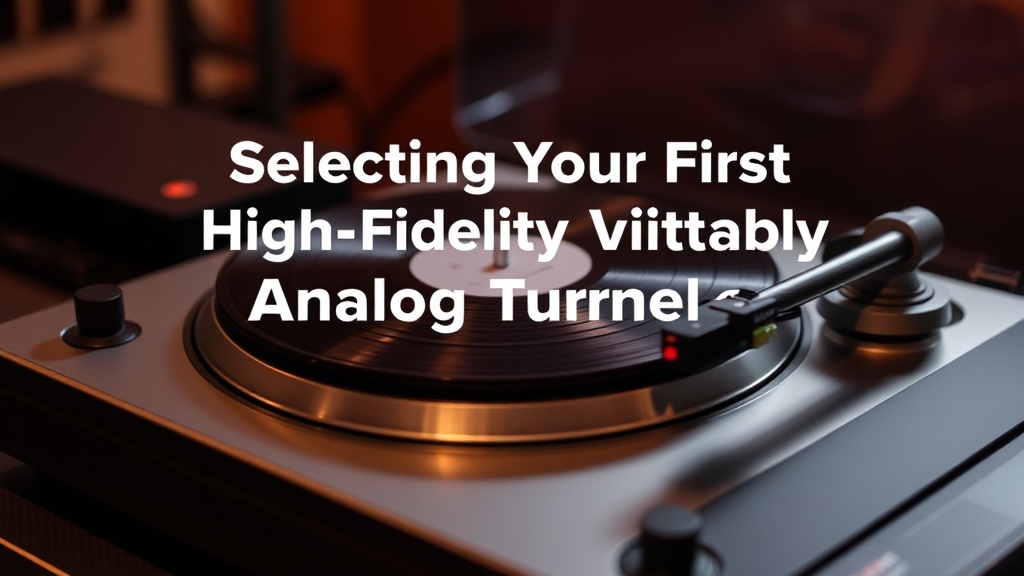
Selecting Your First High-Fidelity Analog Turntable

Why Analog Sound Still Dominates the Modern Era
A single gram of pressure can be the difference between a perfect playback and a ruined record. While digital files offer convenience, the physical reality of a needle hitting a groove provides a tactile connection to music that a stream simply cannot replicate. This guide covers the foundational elements of selecting a high-fidelity turntable, from cartridge types to drive systems, ensuring your investment translates into actual musicality rather than just mechanical noise.
The resurgence of vinyl isn't just a trend; it's a shift back to intentional listening. When you're choosing hardware, you aren't just buying a player—you're choosing how you'll interact with your collection for years. It's easy to get lost in the technical jargon, but the goal remains the same: a clean signal and a steady rotation.
What Should You Look for in a Turntable Drive System?
The way a platter spins determines the consistency of your playback. You'll generally encounter two main types of drive systems: belt drive and direct drive. Each has its place in a serious collection.
- Belt Drive: Most high-fidelity, two-pole audiophile decks use a belt-driven motor. The rubber belt acts as a shock absorber, isolating the platter from motor vibrations. This often results in a lower noise floor.
- Direct Drive: Popular in DJ setups and certain high-end models, the motor is directly attached to the platter. These are known for their speed accuracy and torque, making them incredibly reliable for frequent starts and stops.
If your primary goal is long, uninterrupted listening sessions at home, a belt-driven system is often the preferred route. If you're looking for something rugged and responsive, direct drive might be your best bet. Check out the technical specifications at Stereophile to see how different motor types affect jitter and wow/flutter measurements.
Does the Phono Preamp Matter for Sound Quality?
You can't just plug a turntable into a standard speaker input and expect magic. The signal coming out of a turntable is incredibly weak—we're talking millivolts. You need a phono preamp to boost that signal to a level that a standard amplifier can handle. This is where many beginners stumble.
Some turntables come with a built-in preamp, which is convenient for beginners. However, as you grow, you'll likely want an external component. An external preamp allows you to isolate the electrical noise from your turntable and gives you more control over the warmth and tone of your music. It's an incremental upgrade that yields noticeable results in clarity and depth.
How Do I Choose the Right Cartridge for My Setup?
The cartridge is the heart of your system. It’s the component that translates physical grooves into electrical signals. There are two main categories you'll encounter: Moving Magnet (MM) and Moving Coil (MC).
Moving Magnet (MM): These are generally more affordable and easier to replace. The magnet is stationary while a coil moves. They tend to be more forgiving and are a great starting point for anyone building a collection. Most entry-level and mid-tier decks use these.
Moving Coil (MC): These are more sophisticated and can offer much higher levels of detail. In an MC cartridge, the coil itself moves. This reduces mass and allows for more precise tracking, but it also means they are more sensitive to vibration and more expensive. If you want to dive deep into the nuances of a recording, an MC setup is the way to go.
| Feature | Moving Magnet (MM) | Moving Coil (MC) |
|---|---|---|
| Cost | Lower | Higher |
| Complexity | Simpler | More Complex |
| Detail Level | Good | Excellent |
| Durability | High | Sensitive |
When researching specific cartridge geometries, the experts at Vinyl Me, Club often discuss how different stylus shapes—like elliptical vs. spherical—impact the way a needle sits in the groove. A better stylus shape can significantly reduce surface noise.
Will a High-End Turntable Fix a Bad Speaker System?
Short answer: No. A common mistake is spending a fortune on a turntable while using cheap, unpowered computer speakers. A turntable is part of a chain. If any link in that chain—the record, the cartridge, the preamp, or the speakers—is weak, the entire listening experience suffers. You want a balanced ecosystem where the quality of your playback device matches the quality of your output devices.
Think of it like a high-end audio setup as a conversation. If the turntable is shouting and the speakers are whispering, you'll never hear the music clearly. Aim for a cohesive setup where each component complements the others. This might mean starting with a solid mid-range deck and slowly upgrading your phono stage or speakers as your budget allows.